After interning with The Carter Center's Health Programs, the news releases this week that the cases of Guinea Worm are now under 5,000 makes me more excited than a gluten-free pizzeria. It is close to being the second disease eradicated, after small pox. Nicholas Kristoff and Jimmy Carter are two of the most inspiring people I have ever met in my life, so to see them collaborating on the news propogating the involvement of entities larger than individuals (such as governments) in the fight against international diseases rather than other countries, seems to validate my life's mission in public health.
Jimmy Carter and George W. Bush’s Future
I recommend watching the video
Friday, December 5, 2008

Tuesday, December 2, 2008
Policia
It is most common to see two (young) policemen weaving together through traffic atop an official motorcycle. While riding along in the back of my friend’s car today I saw something new: two (young) policemen, but between them a third man with his arms up in the air, handcuffed together. Looking like they were about ready to fall off, what surprised me most was that it seemed so unsurprising that an arrested man should be transported to wherever??? in this fashion. I sometimes see these police pairs hassling youngsters dressed in baggy pants with died black hair who loiter in park corners, but usually they can be found leaning distractedly against a lamppost without any apparent purpose. Despite their widespread presence in the city, I take for granted the fact that in the US there is less corruption within law enforcement and I know that for the most part I can count on policemen to be actively ‘keeping the peace’ while on duty.
Thanksgiving in Cali
On Thanksgiving morning I woke up to the rambling of a bus beneath me and a view of endless sugarcane fields out the window. My nose hairs burned from the smell of ammonia I had endured the entire night, and I still kept my hood up around my face trying to hide the fact that I was the only female to step on board since we had left Medellin, but I was almost at my destination: Cali.
I have been in relatively close contact with Hilary, one of the other Rotary Ambassadorial Scholars who is stationed in this third-largest Colombian city, and after hitting it off at a meeting in Medellin back at the end of July I resolved to visit her and her host club before she leaves in December. For this reason I rolled into town early on Thursday morning for a wonderful whirlwind visit to the salsa capital of the country. I greatly appreciate her hospitality, and now realize how helpful it is to commiserate with other Americans to pick up on all the different Colombian nuances they are experiencing. Through our long conversations about cultural differences between ‘here and there’, I gained a new perspective on my host country through eyes equally intrigued and insightful as my own.
Cali has grown immensely in the past 20 years, but in a way of which no Colombian is proud. They suffer from more corruption than almost any other city, and the government is still more dictated by mafia and drug cartels than public interest. In the 1980’s there was a destructive earthquake in a predominantly Afro-Colombian town along the Pacific coast, bringing hundreds of thousands of displaced people into Cali. As an extremely racist culture, everyone admits that the influx of a darker-skinned population has led to the demise of the whole city and caustic stereotypes.
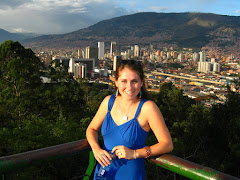
While wandering around an artesania district and climbing up a large hill to a shut-down church with a great view of the city, I saw just how extensive Cali is in comparison to Medellin. With the vastness of the Valle de Cauca welcoming the city’s expansion, it appears much larger and bustling than my part of Colombia when really it is 200,000 people shy of Medellin’s population. I was impressed by the Centro’s old streets and colonial buildings mixed in with glass-plated sky scrapers and new bridges. The Archaeological Museum taught me more about the country’s indigenous population than anything I could find in Medellin, housed in a beautiful old church. After getting a good dose of phallic pottery and shriveled but intact mummies, we headed over to an indigenous art fair where I talked with women and men from all over the country about the complications encountered by their people and admired (as well as bought) beautiful beaded jewelry, woven baskets, and carved salad tongs. I even bought a bottle of coca wine—something of which I had never heard after living a year and a half in the Andes and proved to be quite delicious!
Instead of braving the frustration of recreating a traditional Thanksgiving meal in a country where turkeys are less common than toucans, Hilary and I headed to Crepe’s and Waffles for dinner for the closest food we could find to American. I had a delicious red curry shrimp and quinoa salad, topped off with an ice-cream sundae and a side of hot extra chocolate syrup. If I am allowed any bragging rights in my own blog, I will admit that before leaving Medellin I cut open a small pumpkin sitting on my dining room table as decoration since before Halloween and baked a delicious batch of pumpkin pie filling (gf without the crust!) from scratch following a recipe I found on the internet. November just isn’t the same for me without pumpkin pie, no matter where in the world I find myself.
Friday we got up early and headed out to Cali’s sport center to watch the Colombian National Games. I was introduced to the national sport of ‘Tejo’, which is somewhat like horseshoes with pyrotechnics. Supposedly an indigenous game, teams compete against each other by throwing a conical metal disk at a slanted bed of clay trying to knock it against a circle of gunpowder in the middle to make a large pop, spark, and plume of smoke to ignite the cheers from the excitable spectators. Although I still don’t really understand the rules or point of the game, it was interesting to see something so typically ‘Colombian’.
Next it was off to tennis, where I was itching to slide around on the clay courts with the young girls and boys sweating out the midday heat. After a break for lunch and a visit from an American Fulbright Scholar also working in Cali, we headed over to the stadium to watch Track & Field. Pole Vaulting, the Women and Men’s 800, Long-Jump, and Women’s 5000 were all exciting to witness with the backdrop of the Andes turning into shadows behind the grandstand as the sun set. Teams from the different departments in Colombia compete against each other in all the sports, and I am proud to say that my Antioquia did very well. It seems silly that I should have so much paisa pride after less than six months of living in Medellin, perhaps embellished by my fantasy that I have exercised alongside the athletes competing in the National Games during my morning runs around the Estadio, but it was easy to be partial while getting swept up in the competitive spirit.
The last, and most fascinating, sport we watched was swimming. But even after watching hours of Olympic swimming over the summer waiting for Phelps to compete, I have to say that I have never witnessed any nautical sport as intriguing as what I saw this weekend. Eight girls walked into the stadium in their swimming suits and caps, carrying one large fin. As they lined up on the starting blocks, they put on their fins, placed a snorkel into their mouth, and sat like mermaids at the edge of the pool. At the sound of the whistle they flopped gracefully into the water, keeping their arms outstretched in front of them and repeating an undulating butterfly kick for over 15 minutes (I lost track of the distance). Needless to say, now I want to bring a monofin back with me to the states to impress everyone with my sub aquatic mermaid moves.
It would be a sin to visit Cali without going salsa dancing, so us three American girls went to a classic club with our Colombian pairs and tried to forget that we hadn’t grown up with fluid hips. I hope that people aren’t complimenting my dance skills out of pity, because I do feel like I have greatly improved my Latin dance skills since arriving and no longer need to look at my partner’s feet but rather let myself be carried away by the beat of the music and the pressure of a hand on my back.
Saturday I woke up with sore calves and tense shoulder blades, but ready to relax at the most gorgeous finca I have yet encountered while enjoying an end-of-year party with Hilary’s host Rotary Club Cali San Fernando. With three pools, two of which were natural and fed by waterfalls heading out of the hillside, a large drink bar and dance floor, largest collection of orchids I have EVER seen, and trail down to the river and mountains beyond, I was more than happy to gorge myself on traditional food and wander around marveling at the natural Colombian beauty that never ceases to impress me. All the Rotarians were extremely friendly and welcoming of me as a fellow scholar, although I was a bit intimidated by the way that they raved about Hilary, hoping that I could be complimented with such a strong assessment at the end of my scholarship year. The evening naturally devolved into more food, drink, and dancing—where I was swept around through the evening by old and young Rotarians until my shirt was completely soaked and my face hurt from laughing so much. I absolutely love how Colombians—no matter what age—will dance to any music. Hip-hop, reggaeton, funk, vallenato, and of course salsa all inspire their bodies into motion. I have not seen one person in this country who lacks rhythm.
Sunday morning found me back on a bus for ten hours, riding through more sugar cane fields and up treacherous mountains. Although Cali has great dance culture, awesome graffiti, and less pollution, the weekend made me appreciate Medellin for its Metro, stunning surrounding mountains, strong cultural identity, and hot water.
Thinking Ahead
As much as I want to immerse myself in the present, I do realize that this amazing year will eventually come to an end. In order to keep my options open I have dedicated more time than I would like to remember completing my application for Rollins School of Public Health at Emory University. Let me clarify, in case anyone was doubting, how difficult it is to request transcripts, enlist old professors and bosses for references, and remember all those important activities in which I participated during college. Unreliable internet access made the entire process even more complicated, yet I finally finished and am rewarding myself with Christmastime travels. I have decided that I will be heading back to Atlanta after relinquishing my responsibilities as Ambassadorial Scholar, but am not quite sure if I want to gain more work experience in the public health hub of the US or continue my education. Time and scholarship decisions will tell, but for now I can return my focus to my daily Colombian life.
Jardin
My new personal goal is to get to know as much of Colombia as possible. This means taking advantage of any three day weekends or school breaks, and so although all of my friends had other engagements for the last national holiday I was resolved to visit a new pueblito outside of Medellin. I thus got on a bus on a rainy Saturday evening to head by myself to the famous town of Jardin. It did not stop raining for the entire weekend, but that did not stop me from taking a 4-hour hike through the gorgeous countryside, tromping through banana groves, sloshing through muddy cow pastures, and getting caught on barbed-wire fences as I trespassed on private land. I walked up to a trout farm where I ate lunch with the family running the establishment, consuming the most tasty fried trout, patacones, hogao, and guarapo in Colombia. The parque was full of visiting city-folk, so I sat around with the old couples drinking hot chocolate and watching the kids riding by on horseback. When I tired of the perpetual cold dampness, I headed back to the finca-like hotel with a gorgeous view of the river valley. Inspired by the wet beauty of the landscape, I painted the patio while sitting and talking with the guests filtering through, as well as the caretaker and her polar-fleece sweater-wearing Chihuahua. Despite what people say about the dangers of traveling through Colombia, I find that wherever I go I am greeted by the most friendly people ever who look out for me and make me feel so welcome and well taken care of that I am never left truly alone.
Recent Rotary Activities:
-Bello: Presenting with a Doctorate-seeking Rotarian on familial violence to an audience of mothers and school-age children. I talked about the hotlines and structural services available in the US, and how even though a woman being abused by her husband won’t necessarily be helped if she calls the police, Colombian family structures are so strong that anyone will always have an aunt or second cousin who would take them in if in need. We stressed education about what constitutes violence, whether it is verbal or physical, so that people realize what their rights are. In some parts of the country, over 60% of women report abuse in their home. Imagine what the figures would be if the cases that weren’t reported were included…I was also interviewed after the lecture by the local news station!
-Colpaul factory: Visit with my host Rotary Club to the largest factory in South America making medical supplies that is used within Colombia and exported to other countries. The company is a for-profit sector that supports the university teaching hospital (directed by a Rotarian) ‘Hospital Universitario San Vicente Paul,’ along with 13 parking structures located throughout the city. I don’t think I have ever seen so many plastic bottles and caps in one space in my entire life. Nor have I ever thought about how important sterilized water is in producing IV fluids…
Friday, November 14, 2008
Holy Matrimony!
Dearly beloved...I was fortunate enough to return to the US last week for my first official family wedding. My cousin Ashley has been like an older sister to me since the day I was born; her three extra years giving her plenty of time to be one of my most prominent role-models. It was thus much more emotional than I expected to see her wed off and all grown up right before my very bridesmaid's eyes. She looked absolutely gorgeous, her (now) husband is an awesome addition to our family and makes her happier than anyone else could, and the ceremony contained a good balance between laughs and tears, but now that the whirlwind of family and avoiding reverse culture shock and 5 plane trips is over, I am left stupefied by the idea of...marriage!?!
In the US it is normal for a middle-class woman to get married at 26 years of age, like Ashley. We usually leave home at 18 to live at college, figure out how to live on our own and get accustomed to independence, graduate and start working or continue our studies to get a better job, meet the person of our dreams, and have a few years to date and possibly cohabit before sealing the deal. At least that is what I have grown up thinking.
Since coming to Colombia I am surprised at how few of my friends of a similar age are considering marriage before the age of 30.* Even those who have been in relationships for eight years and have a good job. This has struck me as surprising since in the past month I have been alerted every week that a new friend back home is engaged, and makes me wonder why things here are so different. Considering people generally live at home with the parents until they get married, I thought that maybe this put some sort of imposition on one's personal independence. When you can never bring someone home and always have to include family members in one's romantic relationship things obviously progress in a different manner than if you have lots of space--physical and metaphorical. But when I hopped in a cab the other day on my way to school as it started to rain outside, I was intrigued to hear two women discussing why youngsters these days get married so late in life. They were saying it was because there was a cultural aversion to commitments, that the couple want to be established (with a car, finca, apartment, job, money, etc. etc.) before they settle down, like the comfort of being taken care of at home, and in general are basking in the different opportunities and freedoms their generation is allowed.
Which makes me wonder...is marrying young(er) another first-world privilege? Because it is easier for us to make our own way in the world, does that allow us the ability to choose our mates easier too? Or is this jut a reflection of the upper class status mentality? Obviously very few people can afford all of the amenities mentioned above, but even people of different socioeconomic standings get married later in life, if at all. The generations of my friends' parents and grandparents wed at age 25 or 25 and early 20's respectively, so what could have caused such a huge cultural change in such a short amount of time?
Or, to look at marriage in the reverse cultural standpoint, why do people in the US deem it so acceptable to get married before the age of 30? Since divorce has become such a hazardous social epidemic maybe we should be afraid of commitment until we no longer crave single 'freedom' and 'know what we want' (if that is not overly cliche). If young North Americans thought it strange to tie the knot before completing three decades perhaps they would be more likely to keep their families together for the long haul.
For whatever reason, all my girlfriends at the university--who are all at least 26--started screeching when they heard that they were older than my now-wed cousin...
*Mind you, more women have children before the age of 30 than are married. Teen pregnancies and starting a family out of wedlock is a huge issue in Colombia.
Subscribe to:
Posts (Atom)