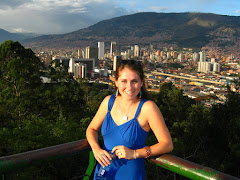
For the much-needed 'puente' (three-day weekend) celebrating 'el dia de la raza': aka Columbus Day, I had many travel options. Wanting something relaxing and further away than I would normally be able to visit in a weekend, I chose to go to the Caribbean coast with the friends of a friends's boyfriends brother. Coveñas is a 10-hour drive from Medellin, which was an awesome road-trip to do in a car because I got to see the change in landscape from the Andes to the jungle to the marshy cattle-grazing prairies. Although I should have anticipated the intentions behind 15 friends migrating to the beach for a weekend, I was not able to keep up with their 24-hour partying gala. Instead, I played the true gringa and lay by myself on the beach, sober, with my book avoiding the sun and taking power swims for exercise. By excluding myself from some of the activities I unintentionally offended their group culture, and felt more strongly than ever the cultural differences between my US upbringing and paisa friends. The vallenatos were on full blast until 4 in the morning, the rum and aguardiente never stopped flowing, and the ceviche/shrimp coctail vendors walking up and down the beach had loyal customers for 3 days straight. It was like Spring break for hard-working 30 year olds. Awesome, yes, but not when I was needing to sleep in and recover from the accumulated sleep-deprivation of many grueling weeks. More than anything it made me realize I still have a long way to go before I adequately adapt to living in Colombia, and the entire weekend served as a wake-up call to remind me that after being here for 4 months I have lots of close friends whose company I always enjoy and with whom I should be focusing my rare spare time even if it means spending a week at a finca rather than lying on an idyllic Caribbean beach with desconocidos.
Monday, October 27, 2008
Coveñas
For the much-needed 'puente' (three-day weekend) celebrating 'el dia de la raza': aka Columbus Day, I had many travel options. Wanting something relaxing and further away than I would normally be able to visit in a weekend, I chose to go to the Caribbean coast with the friends of a friends's boyfriends brother. Coveñas is a 10-hour drive from Medellin, which was an awesome road-trip to do in a car because I got to see the change in landscape from the Andes to the jungle to the marshy cattle-grazing prairies. Although I should have anticipated the intentions behind 15 friends migrating to the beach for a weekend, I was not able to keep up with their 24-hour partying gala. Instead, I played the true gringa and lay by myself on the beach, sober, with my book avoiding the sun and taking power swims for exercise. By excluding myself from some of the activities I unintentionally offended their group culture, and felt more strongly than ever the cultural differences between my US upbringing and paisa friends. The vallenatos were on full blast until 4 in the morning, the rum and aguardiente never stopped flowing, and the ceviche/shrimp coctail vendors walking up and down the beach had loyal customers for 3 days straight. It was like Spring break for hard-working 30 year olds. Awesome, yes, but not when I was needing to sleep in and recover from the accumulated sleep-deprivation of many grueling weeks. More than anything it made me realize I still have a long way to go before I adequately adapt to living in Colombia, and the entire weekend served as a wake-up call to remind me that after being here for 4 months I have lots of close friends whose company I always enjoy and with whom I should be focusing my rare spare time even if it means spending a week at a finca rather than lying on an idyllic Caribbean beach with desconocidos.
Rotary Activities
Not to worry, the reason why I haven't posted for over a month is because I have been managing an action-packed schedule filled mostly with Rotary events. Including:
--RYLA Seminar (Rotary Young Leader Awards): An international seminar offered by Rotary clubs to promote youth leadership in the communities. Last weekend I attended one held by the Club Rotario Envigado entitled "Democracy and Youth Participation." It involved two conferences given by government officials, a visit from the Envigado mayor who himself attended RYLA conferences as a teenager, 4 interactive workshops on human rights and the culture of democracy, lots food, and even a Rotary-sponsored party complete with DJ and beverages. Although most of the students who attended were from Interact (14-18 years old), and the level of the discussions and information presented was at a lower level than I had hoped, I still learned a lot about the different constitutional rights to which Colombian youngsters are entitled and what positions of leadership/representation within the schools and municipalities they can hold. My presence was important to inspire these aspiring youngsters to utilize the possibilities Rotary offers through international scholarships, emphasizing that they shouldn't get discouraged by their economic or national situation. As a highschooler I was very involved in committees and events supporting diversity and open discussion, but I don't remember ever hearing teenagers so impassioned about their rights with resolve to change the system. Perhaps it is a result of the general apathy that has overtaken the US, but it made me realize more than anything how lucky I was to grow up in a country, and more specifically a community, where the young population has the ability to participate in the system.
--Visiting Rotary clubs all over the city to make presentations: Club Rotario Medellin Nuevo, Club Rotario Medellin Occidente, Club Rotario Nutibara, Club Rotario Itagui Santamaria, Club Rotario Envigado, Club Rotario Sabaneta
--Become more involved in my host Club Rotario Medellin--the largest and second oldest club in the country. Many of the members are some of the most wealthy and powerful people within Colombia, but all are very friendly, tell hilarious jokes, and make a huge impact within the community. I now show up at meetings every Thursday and not only remember people's names but have ongoing conversations with them and am always greeted with big smiles. This week the governor of Antioquia came (with his very own secret service) to speak about development projects in the department including bettering education and safety, hydroelectic plants, reforestation, mining expansion, and increasing public participation among other things. The club also gives out an annual award of around $75,000 to people who have contributed immensely to the community; this year's cash prize went to environmentalists who established Medellin's famous botanical gardens and have created large natural reserves to protect the valuable flora and fauna found in the area.
--Attended a regional seminar for new and old Rotarians to inspire within them the spirit of Rotarism and review project and monetary goals for the year. Afterwards went to an "integration" party with members of my host club at the most gorgeous finca I have ever seen that reminded me of a house out of an old movie complete with famous art and full service.
--Become familiar with the 4280 District Governor by attending meetings at clubs throughout the city. Also took a day trip to Ciudad Bolivar where there is a small but strong club; stopping throughout the coffee region to take pictures, try local treats, avoid the massive landslides almost making the roads impassible, falling more in love with the gorgeous Colombian scenery, and learning about how a year ago the same region was dominated by guerrillas and too dangerous to visit.
--Started a new project at a house for HIV-positive children with the Rotaract Club Medellin; I will be teaching them art lessons and taking them on visits to museums throughout the city.
--Volunteering once a week at an amazing organization for children with Spinal Bifida, run by the district governor elect, where I also lead art projects and participate in music/stretching activities for babies and tottlers affected by the disease.
--Attended an induction ceremony for a community police program sponsored by the Club Rotario Nutibara; establishing an important relationship between the police forces and the Rotary clubs in the city to get logistical safety from them for projects carried out in dangerous communities or for transporting children. I was very impressed with the calibur of men and woman in the program since most of them speak at least one language, are well educated, extremely dedicated to the police force, and have undoubtable faith in the public institution.
--Helped run a massive eye-examination program also with the Club Rotario Nutibara offered at a clinic in a lower-income neighborhood; reviewing over 15o children in one Saturday morning for eye problems, referring around 30 of the worst cases to an optomologist (also the club president!), and then outfitting those in need with donated glasses.
I love my 'job'.
Monday, September 22, 2008
Morning Musings
Going about my morning business I consistently notice several things:
1) The water flowing through the 'canalizacion' down the mountainside settlements, through my neighborhood, and toward the center of the city to join up with the big river always smells fresh and perfumed like laundry detergent even though it is muddy brown in color. My senses automatically equate the sudsy smell of detergent with cleanliness so it always takes me aback when I look down into the tumultuous tides and realize that lots of someones upstream deemed the tributary a good laundry resource. And then I realize how lucky I am to always have lived with a fresh (running!) water source; never worrying about dirty sediment getting stuck in the wrinkles of washed clothes. But then again I rarely think about what sort of smell my post-laundry water is being observed by someone downstream...
(Speaking of laundry, having not used a dryer for the past two and a half months I realize how much more energy efficient it is to live in a warm climate. However, I wonder if the extra electricity that I use turning the lights on at 6:30 every night since it gets dark so early evens out my usage...)
2) Waking up to the sound of horse's hooves clip-clopping atop asphault never ceases to surprise me. Carts drawn by men or horses make their daily rounds through neighborhoods selling flowers, fresh avocados, and an array of produce. I just wish that they didn't always bring along their megaphones for the incessant drone of "Piña por mil, aguacate aguacate. Mandarinas: diez por mil."
3) Usually one thinks of the area surrounding a university as catering to the student population. Immediately around the Facultad there are lots of papelerias, restaurants and ice cream shops, but one street up is the longest stretch of funeral homes with hearsts parked outside that I have ever seen. It is quite depressing to walk by them every day thinking about the sad families sitting around inside deciding upon coffins and staying up all night with the bodies of loved ones. I just hope that this 'death row' doesn't inhabit this exact location because so many college students are passing away...
Wednesday, September 17, 2008
Emphasizing the Aesthetic
Medellin (and Colombia) are known world-wide for their beautiful women. Imagine your stereotypical Latin beauty with long dark hair, cinnamon skin, wide smile, salsa-dancer hips, and the ability to devour you with one glance...and you are basically conjuring all the paisas flouncing about Medellin.
Now just like anywhere else with famous females, Colombians place a HUGE importance on appearances. Since Medellin is home to many clothing factories and fashion comes cheap, girls here are obsessed with shoes, shirts, jewelry, bags: shopping. They get their nails done every week, (also very inexpensive and a common practice by men too), straighten their hair in empty classrooms during lunch, and hog the bathroom mirrors. It's not like the women here need to make themselves more beautiful, it's just...fun (?).
(To be fair, several of my male friends have complained that they are not admitted to normal clubs around the city if they don't keep a clean beard or are wearing ragged clothes. I wonder if this is some sort of class discrimination or an extension of aesthetic importance.)
I can feel my inner tomboy getting swept away with the desire to partake in this public runway. But it also makes me wonder: how important is the fact that so many of these women are well-educated and working important jobs--is it more important than what meets the eye?
While previously living in Latin America I remember being struck by the way in which male attention served as a barometer for my appearance; every day that I leave the house I know if I have put on an attractive outfit or applied the right combination of make-up by the number of cat-calls I receive before arriving at the Metro station. "Tsssssssss...mona, que linda!" (yes, they ironically call those with an inclination toward a lighter complexion and features 'monkey'). It all sounds incredibly shallow, I know. But I do find that people, especially Rotarians, generally receive me better when I dress fashionably and doll myself up.
I have conducted several self-led experiments in which I have donned a dress and heals to one Rotary meeting then a less fashionable outfit to the next meeting, making sure to engage in just as interesting of conversations while demonstrating equal levels of self-confidence and outgoing bubbliness. The obvious result was that when looking more feminine and pretty people were not only noticeably more receptive and friendly towards me but also more complimentary of the content of my presentations.
What message does this send to women? I realize it is a big generalization, but the conclusion would be that in order for our ideas to be taken more seriously we have to first attract people's visual appreciation.
R-E-S-O-L-V-E
Things to do before turning 25:
--Graduate from college (check)
--Work for an ex-president (check)
--Live paycheck to paycheck without adequate health insurance (check)
--Drive cross-country (double check)
--Live in another country on my own for a year (check)
--Accumulate a hefty stack of stories I would not want to tell my future children (check)
--Run a half marathon (...check)
What better way to get to know a new city than running 21 km through downtown and unknown neighborhoods?

After talking the talk for two years, I finally bit the bullet and ran the run. Without really training, I knew I would be disappointed in myself if for the third time in a row (1. San Diego Marathon Spring 2007, 2. Peachtree Road Race in Atlanta Spring 2008) I backed out of the opportunity to push my physical limits in a test of human insanity. So on September 14 I completed the Mediamaraton Medellin (half marathon of Medellin).
Since my arrival I have been jogging 4-5 times a week around the Estadio right down the street, a safe and well-landscaped place to get outside in the mornings and stay in some sort of shape that doesn't resemble a blob. The furthest I have run in the past year is probably 6 miles, or half of a half marathon. But when I stepped out onto the course Sunday morning (after a good breakfast, a week without alcohol, and a few days of major mental psyching), as soon as I crossed the starting line I couldn't stop running for the next 13.3 miles. Something about the mass movement of 17,000 people, comraderie among strangers, and the beauty of the city in the morning helped my body settle into a comfortable rhythm for a little less than two and a half hours.
The race started and finished literally three blocks from my front door, which made the entire experience seem like a friendly neighborhood activity. I was impressed by how many serious runners showed up from many different countries; co-ed teams from Peru, a few gringos like myself, and the expected Kenyans (who took first and second). In general the large-scale, city-wide promotion of athletic activity has been very obvious and successful from what I can tell, and it paid off with the number of participants and fans that showed up for the 1K kid's race, 5K family race, and the 21K competition. Throughout the race I saw several fathers running while holding their sons' hands, a father-daughter team, and lots of couples striding along together. Although I was somewhat disappointed that I didn't have anyone I knew with whom to share my first big race, it was fun to feel like part of the Medellin community I call home.
My goal I set for myself was to finish, but not push my body to the point of injury just to get there, and I fully surprised the doubtful Alina by mustering enough energy to sprint across the finish line with only minor soreness and tired feet. Somewhere between KMs 12 and 13 I became fearfully tired, but adrenaline serves as a powerful natural drug and I relied on its rush to get over the hump and push my body through the second half of the race at the same pace as the first. If you can't tell, I am very proud of myself and have set my sights on other half marathons in the near future.
Now back to my To-Do List:
--get published
--start post-graduate studies
--skydiving??
Loneliness
Living alone has its benefits; privacy, independence, tranquility, and nobody judging my frequent OCD tendencies. But after a month and a half of living in an apartment owned by someone else that I cannot personalize is starting to take its toll. Eating meals with a book makes my food taste less, hearing things that go bump in the night wakes me up with a heart-thumping start, and cleaning up after myself all the time just seems silly when nobody will notice if I leave a dirty plate in the sink for a day.
I do have two new roommates, Isabella and Hector (mama and baby respectively) who live on my bathroom walls...but seeing as they are tropical salamanders they don't really offer much as far as dinner-time conversation goes but do poise interesting voyeuristic questions.
Of course I am busy at school all day, have Rotary meetings at night, and friends to explore the city with on the weekends, but nothing is quite the same as having someone--anyone--to vent to after a tough day or as a safety precaution know if I don't come home when I should. I am torn between over-involving myself in Italian classes and volunteer hours or finding other foreign roommates to get me through future months, but for the time being I find myself wistfully appreciating the amazing support networks I have back home.
Speaking the English
In the course of two months I have managed to be converted into 'Resident English Speaker' at the Facultad Nacional de Salud Publica (FNSP). Who has done this converting? My friend the Dean has seen me fit to rent out like the latest version of Rosetta Stone; a trend picked up by a different faculty member each day.
It all started with the suggestion that I start weekly English conversation classes as part of a community service project. Due to the large number of students and professors who study English but do not get much practice at listening or speaking, I serve as their perfect link between books and real-life necessity. On Mondays and Tuesdays I now spend my two lunch hours animating my students to practice formulating gramatically correct simple questions like "Where did you hang out last night?" or discussing national environmental concerns. As wonderful as it is to know that I am helping people with their English communication skills, I selfishly love meeting new interesting friends and leading discussions that benefit my own knowledge of Colombian issues.
Along with assuming the position of Mizz Teacher, I also serve as chief English document consultant. At first it was exciting to be called into a new office and asked what a professor in Germany was requesting in the most recent installment of an academic email conversation. It makes me feel important, not to mention that I am learning infinitely valuable information about the international public health community. For example, I have worked on important national proposals to the WHO for a project linking topics of academic research and government policy making (with a lot of funding money on the line). Several people are relying on my comments on another proposal so they can participate in an international qualitative research exchange learning project with the University of Chicago. But because the FNSP has been so generous to open up so many other opportunities for me, I find it difficult to turn away any English solicitor even though I am frequently distracted from my own projects with the high volume of work being presented to me. And as much as I try to fly incognito, it's not like I can just blend in as one of the other students when everywhere I go the 'Gringa' flag waves high above my blue eyes, light brown hair and different accent.
Maybe this is a good lesson for familiarizing myself with personal linguistic limits, because I have also found myself in some rather humiliating situations. Two weeks ago I was asked to translate the entire two-hour presentation of a professor coming from UC Irvine for an international conference on Occupational Health. Although I received his 60 slides with ample time to familiarize myself with the correlation between hypertension and job tension, followed by an hour-long one-on-one explanation of his life's work, I still lacked the depth of medical terminology to adequately convey the importance of the research. It turns out that his daughter attended Pitzer College and is currently pursuing her Doctorate in Anthropology by completing field work in the Caribbean, so we not only immediately had a common connection but a mutual respect. Unfortunately, by the end of four hours of translating for the presentation, social interaction, and professional panel, I was ready to burst into tears. I felt like even though I tried my hardest, I had botched up an important cross-cultural opportunity for Latin American specialists to impress upon a famous North American doctor their valuable research, reflected poorly on my Alma Mater, and had failed as an Ambassador of Goodwill.
In the future, I will know to pass on these sorts of requests to those professors who I know have a much higher level of multicultural and multilingual competence (and who have also pursued several degrees of graduate education to understand systolic ambulatory blood pressure) than myself, while gladly accepting projects that hone my forte of ruthless peer reviews. I guess that despite feeling more comfortable each day in my second tongue I still have a lot of Spanish to learn before I can consider myself fully fluent.
Subscribe to:
Posts (Atom)