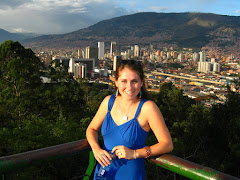
Going about my morning business I consistently notice several things:
1) The water flowing through the 'canalizacion' down the mountainside settlements, through my neighborhood, and toward the center of the city to join up with the big river always smells fresh and perfumed like laundry detergent even though it is muddy brown in color. My senses automatically equate the sudsy smell of detergent with cleanliness so it always takes me aback when I look down into the tumultuous tides and realize that lots of someones upstream deemed the tributary a good laundry resource. And then I realize how lucky I am to always have lived with a fresh (running!) water source; never worrying about dirty sediment getting stuck in the wrinkles of washed clothes. But then again I rarely think about what sort of smell my post-laundry water is being observed by someone downstream...
(Speaking of laundry, having not used a dryer for the past two and a half months I realize how much more energy efficient it is to live in a warm climate. However, I wonder if the extra electricity that I use turning the lights on at 6:30 every night since it gets dark so early evens out my usage...)
2) Waking up to the sound of horse's hooves clip-clopping atop asphault never ceases to surprise me. Carts drawn by men or horses make their daily rounds through neighborhoods selling flowers, fresh avocados, and an array of produce. I just wish that they didn't always bring along their megaphones for the incessant drone of "Piña por mil, aguacate aguacate. Mandarinas: diez por mil."
3) Usually one thinks of the area surrounding a university as catering to the student population. Immediately around the Facultad there are lots of papelerias, restaurants and ice cream shops, but one street up is the longest stretch of funeral homes with hearsts parked outside that I have ever seen. It is quite depressing to walk by them every day thinking about the sad families sitting around inside deciding upon coffins and staying up all night with the bodies of loved ones. I just hope that this 'death row' doesn't inhabit this exact location because so many college students are passing away...
Monday, September 22, 2008

Wednesday, September 17, 2008
Emphasizing the Aesthetic
Medellin (and Colombia) are known world-wide for their beautiful women. Imagine your stereotypical Latin beauty with long dark hair, cinnamon skin, wide smile, salsa-dancer hips, and the ability to devour you with one glance...and you are basically conjuring all the paisas flouncing about Medellin.
Now just like anywhere else with famous females, Colombians place a HUGE importance on appearances. Since Medellin is home to many clothing factories and fashion comes cheap, girls here are obsessed with shoes, shirts, jewelry, bags: shopping. They get their nails done every week, (also very inexpensive and a common practice by men too), straighten their hair in empty classrooms during lunch, and hog the bathroom mirrors. It's not like the women here need to make themselves more beautiful, it's just...fun (?).
(To be fair, several of my male friends have complained that they are not admitted to normal clubs around the city if they don't keep a clean beard or are wearing ragged clothes. I wonder if this is some sort of class discrimination or an extension of aesthetic importance.)
I can feel my inner tomboy getting swept away with the desire to partake in this public runway. But it also makes me wonder: how important is the fact that so many of these women are well-educated and working important jobs--is it more important than what meets the eye?
While previously living in Latin America I remember being struck by the way in which male attention served as a barometer for my appearance; every day that I leave the house I know if I have put on an attractive outfit or applied the right combination of make-up by the number of cat-calls I receive before arriving at the Metro station. "Tsssssssss...mona, que linda!" (yes, they ironically call those with an inclination toward a lighter complexion and features 'monkey'). It all sounds incredibly shallow, I know. But I do find that people, especially Rotarians, generally receive me better when I dress fashionably and doll myself up.
I have conducted several self-led experiments in which I have donned a dress and heals to one Rotary meeting then a less fashionable outfit to the next meeting, making sure to engage in just as interesting of conversations while demonstrating equal levels of self-confidence and outgoing bubbliness. The obvious result was that when looking more feminine and pretty people were not only noticeably more receptive and friendly towards me but also more complimentary of the content of my presentations.
What message does this send to women? I realize it is a big generalization, but the conclusion would be that in order for our ideas to be taken more seriously we have to first attract people's visual appreciation.
R-E-S-O-L-V-E
Things to do before turning 25:
--Graduate from college (check)
--Work for an ex-president (check)
--Live paycheck to paycheck without adequate health insurance (check)
--Drive cross-country (double check)
--Live in another country on my own for a year (check)
--Accumulate a hefty stack of stories I would not want to tell my future children (check)
--Run a half marathon (...check)
What better way to get to know a new city than running 21 km through downtown and unknown neighborhoods?

After talking the talk for two years, I finally bit the bullet and ran the run. Without really training, I knew I would be disappointed in myself if for the third time in a row (1. San Diego Marathon Spring 2007, 2. Peachtree Road Race in Atlanta Spring 2008) I backed out of the opportunity to push my physical limits in a test of human insanity. So on September 14 I completed the Mediamaraton Medellin (half marathon of Medellin).
Since my arrival I have been jogging 4-5 times a week around the Estadio right down the street, a safe and well-landscaped place to get outside in the mornings and stay in some sort of shape that doesn't resemble a blob. The furthest I have run in the past year is probably 6 miles, or half of a half marathon. But when I stepped out onto the course Sunday morning (after a good breakfast, a week without alcohol, and a few days of major mental psyching), as soon as I crossed the starting line I couldn't stop running for the next 13.3 miles. Something about the mass movement of 17,000 people, comraderie among strangers, and the beauty of the city in the morning helped my body settle into a comfortable rhythm for a little less than two and a half hours.
The race started and finished literally three blocks from my front door, which made the entire experience seem like a friendly neighborhood activity. I was impressed by how many serious runners showed up from many different countries; co-ed teams from Peru, a few gringos like myself, and the expected Kenyans (who took first and second). In general the large-scale, city-wide promotion of athletic activity has been very obvious and successful from what I can tell, and it paid off with the number of participants and fans that showed up for the 1K kid's race, 5K family race, and the 21K competition. Throughout the race I saw several fathers running while holding their sons' hands, a father-daughter team, and lots of couples striding along together. Although I was somewhat disappointed that I didn't have anyone I knew with whom to share my first big race, it was fun to feel like part of the Medellin community I call home.
My goal I set for myself was to finish, but not push my body to the point of injury just to get there, and I fully surprised the doubtful Alina by mustering enough energy to sprint across the finish line with only minor soreness and tired feet. Somewhere between KMs 12 and 13 I became fearfully tired, but adrenaline serves as a powerful natural drug and I relied on its rush to get over the hump and push my body through the second half of the race at the same pace as the first. If you can't tell, I am very proud of myself and have set my sights on other half marathons in the near future.
Now back to my To-Do List:
--get published
--start post-graduate studies
--skydiving??
Loneliness

Living alone has its benefits; privacy, independence, tranquility, and nobody judging my frequent OCD tendencies. But after a month and a half of living in an apartment owned by someone else that I cannot personalize is starting to take its toll. Eating meals with a book makes my food taste less, hearing things that go bump in the night wakes me up with a heart-thumping start, and cleaning up after myself all the time just seems silly when nobody will notice if I leave a dirty plate in the sink for a day.
I do have two new roommates, Isabella and Hector (mama and baby respectively) who live on my bathroom walls...but seeing as they are tropical salamanders they don't really offer much as far as dinner-time conversation goes but do poise interesting voyeuristic questions.
Of course I am busy at school all day, have Rotary meetings at night, and friends to explore the city with on the weekends, but nothing is quite the same as having someone--anyone--to vent to after a tough day or as a safety precaution know if I don't come home when I should. I am torn between over-involving myself in Italian classes and volunteer hours or finding other foreign roommates to get me through future months, but for the time being I find myself wistfully appreciating the amazing support networks I have back home.
Speaking the English
In the course of two months I have managed to be converted into 'Resident English Speaker' at the Facultad Nacional de Salud Publica (FNSP). Who has done this converting? My friend the Dean has seen me fit to rent out like the latest version of Rosetta Stone; a trend picked up by a different faculty member each day.
It all started with the suggestion that I start weekly English conversation classes as part of a community service project. Due to the large number of students and professors who study English but do not get much practice at listening or speaking, I serve as their perfect link between books and real-life necessity. On Mondays and Tuesdays I now spend my two lunch hours animating my students to practice formulating gramatically correct simple questions like "Where did you hang out last night?" or discussing national environmental concerns. As wonderful as it is to know that I am helping people with their English communication skills, I selfishly love meeting new interesting friends and leading discussions that benefit my own knowledge of Colombian issues.
Along with assuming the position of Mizz Teacher, I also serve as chief English document consultant. At first it was exciting to be called into a new office and asked what a professor in Germany was requesting in the most recent installment of an academic email conversation. It makes me feel important, not to mention that I am learning infinitely valuable information about the international public health community. For example, I have worked on important national proposals to the WHO for a project linking topics of academic research and government policy making (with a lot of funding money on the line). Several people are relying on my comments on another proposal so they can participate in an international qualitative research exchange learning project with the University of Chicago. But because the FNSP has been so generous to open up so many other opportunities for me, I find it difficult to turn away any English solicitor even though I am frequently distracted from my own projects with the high volume of work being presented to me. And as much as I try to fly incognito, it's not like I can just blend in as one of the other students when everywhere I go the 'Gringa' flag waves high above my blue eyes, light brown hair and different accent.
Maybe this is a good lesson for familiarizing myself with personal linguistic limits, because I have also found myself in some rather humiliating situations. Two weeks ago I was asked to translate the entire two-hour presentation of a professor coming from UC Irvine for an international conference on Occupational Health. Although I received his 60 slides with ample time to familiarize myself with the correlation between hypertension and job tension, followed by an hour-long one-on-one explanation of his life's work, I still lacked the depth of medical terminology to adequately convey the importance of the research. It turns out that his daughter attended Pitzer College and is currently pursuing her Doctorate in Anthropology by completing field work in the Caribbean, so we not only immediately had a common connection but a mutual respect. Unfortunately, by the end of four hours of translating for the presentation, social interaction, and professional panel, I was ready to burst into tears. I felt like even though I tried my hardest, I had botched up an important cross-cultural opportunity for Latin American specialists to impress upon a famous North American doctor their valuable research, reflected poorly on my Alma Mater, and had failed as an Ambassador of Goodwill.
In the future, I will know to pass on these sorts of requests to those professors who I know have a much higher level of multicultural and multilingual competence (and who have also pursued several degrees of graduate education to understand systolic ambulatory blood pressure) than myself, while gladly accepting projects that hone my forte of ruthless peer reviews. I guess that despite feeling more comfortable each day in my second tongue I still have a lot of Spanish to learn before I can consider myself fully fluent.
Friday, August 29, 2008
Running the Run-Around
 Upon entering the country for the second time, an immigration official stamping my passport casually told me that I would have to go to the Department of Security within the first two weeks to get a foreigner's identification card otherwise I would technically be staying in the country illegally. Oh. Why didn't the consulate of the other immigration official who let me into the country in July tell me anything about that?
This meant that I spent all of last Friday running around the city trying to get all the necessary documents in order. First to DAS at 7:30 am to pick up the official list. I then walked around the Belen neighborhood to 4 different laboratories until I found one that would test for my blood type so early in the morning. (The woman pricking my finger thought that my name should be a web address because of how silly of a last name "Shaw" is: www.alinashaw.com). Two copies of that certificate, two copies of the biographical page of my passport, two copies of my visa, two copies of pretty much every other important document that tells anything about me. Six photographs, with a blue background and no gloss. I could only pay the $40 processing fee at one bank in the city which is not accessible by Metro, so I trekked up there and went through the most insane security I have ever seen at anywhere but an airport: I had to leave everything but my wallet in a locker outside the main room and then go through a device that checked for explosives by blowing spurts of air at me. Oh yeah, and make two copies of that receipt. I can only imagine what people applying for visas and green cards in the US have to go through...
By the time I went back to the office Monday morning and finally started getting my piles of paperwork processed, I was halfway expecting that I had forgetten one document and have to wait in the long line all over again. But luckily my perfectionism paid off and I just had to sit in a swivel chair for half an hour while a woman entered all my information into an old-fashioned ledger and cut and pasted my card into existence. As a final touch she made me go into a back room and proceeded to fingerprint every part of my hand she could blacken with ink. Each forefinger four times, every other finger at least twice. Palm, all fingers together, heel. I was about to ask her if I should take off my shoes and socks so she could print my toes just to cover all our bases. But she didn't seem to be in the mood for humor, not with the stack of everyone else's papers waiting at her desk to become part of the national identification process. At least I know that if any of my fingers gets chopped off accidentally they will have its print on file so they know to whom it should be returned...
So I now have a temporary card and cedula number I can give to the pharmacist when he asks me if I want to be entered into their free-stuff lottery. Despite the hassle and the three days of lost work, I guess for the sake of my own safety it is good that the Colombian government can track me throughout the year.
An example...

left: guavas, red onions, avocados, green plantains, tomatoes, beets, red bell peppers, limes, red grapes, criollo potatoes, and fresh beans.
right: a soup/stew made with
 beans, a diced plantain, half a tomato, an onion, several cloves of garlic, and spices with slices of tomato, avocado and corn bread on the side. (not shown is the fresh guava juice I blended up to accompany the meal). yum!
Although I don't think organic certification really exists or would matter here, I do know that every piece of produce came from nearby. Some of it I even bought at a little store down the road that just sells fruit and veg and whose tag line is: "Direct from the fields to your house!"
**I just wanted to acknowledge the fact that my mother is the person kind as to internationally lend me Animal, Vegetable, Miracle. A year and a half ago we got into a very heated discussion (one might even consider it an argument) in the car while my parents were visiting me during family weekend at Scripps. I was saying that organic certification has lost most of the potency it once held since the organic food industry is just as corrupt with problems and it is now better (for your health and the world) to support local. My mother, on the other hand, maintained that organic was still a safer bet since the consumer knows that pesticides aren't used.
I think that the deeper undercurrent raising our personal investment in the topic was based on the fact that my parents lovingly raised us on extremely healthy, home-made food into which much consideration was involved. And by repudiating organics my mom felt like I was disregarding the sacrifices they had made to feed me as best they could--which I definitely wasn't since I think they did an amazing job at solving our family's odd but serious health issues by changing our diet. Before we remodeled our old house, we even had a huge garden that provided us with most of our produce. Fifteen years ago organic was the cutting-edge of health food, and they were right in there with the rest of the crazies preaching about the harmful effects of pesticides on the nation.
That February night in 2007 I challenged my mother to research the new local food movement and see if she couldn't update her knowledge on the current food situation. The last time I visited my parent's kitchen in July, they had a cornucopia of local produce spread out on the counter that they had received from their weekly subscription to a local food co-op. They recently had ordered half a free-range buffalo from Montana to replace the red meat they usually bought from the market, and made me try the local honey they use in their morning tea whcih supposedly helps build up immunity to airborne allergens. When I looked a the hallway bookshelf, I was greeted with the spines of different non-fiction books on the local food movement and sustainable farming. Out in the backyard my parents had even started growing all their own herbs, eggplants, fruit trees, and tomatoes! I quickly realized that my mom and dad had truly taken our conversation to heart and learned enough to adapt their lifestyles to the concepts I had preached even more than I have done for myself; making me somewhat of a hyppocrite. But really, it was just one more example confirming my belief that I have the coolest parents ever and feel increasingly lucky to have been raised by them!
Subscribe to:
Posts (Atom)